Before the Stopwatch: How Runners Kept Time
Before the stopwatch, runners used public clocks and agreed signals. Learn what each method could tell them, and how it shaped a run.
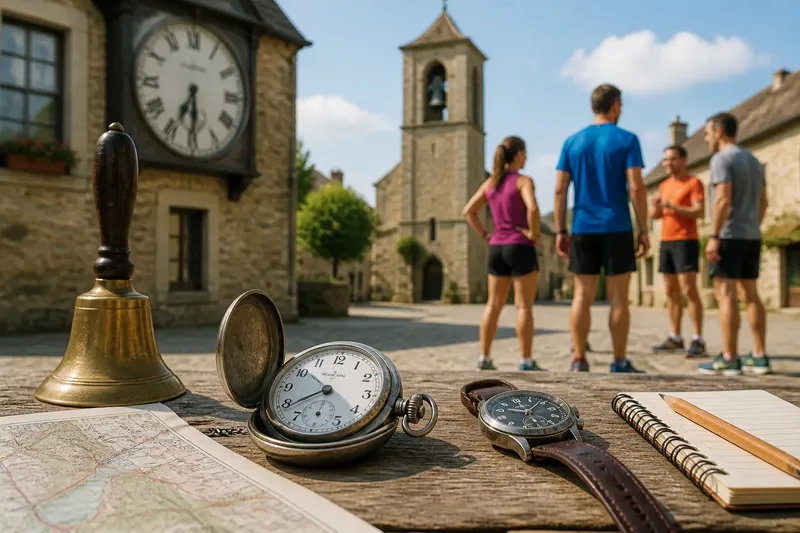
The common mistake is to imagine that runners needed a personal watch to organize a run. Before the stopwatch, a church bell, a town clock, or an agreed meeting time could serve—though each answered a different question. These methods make more sense when tied to the settings where they were useful, rather than treated as one universal system.
There was no single historical method shared by every runner, and the surviving details depend on place and period. The examples below describe practical possibilities, not claims that every runner used them. Their limits are as revealing as their uses.
A bell could organize a communal outing
In a town where a church bell marked the hour, a group could agree to meet at a gate after hearing it. The bell offered a common signal, not a personal elapsed-time reading. It helped people coordinate a departure or rendezvous without asking each runner to carry a clock.
That distinction mattered. If the group wanted to gather and return together, a shared signal might be enough. If one runner wanted to know precisely how long an individual stretch had taken, the bell could not answer. It marked an event everyone could hear; it did not follow each person along the road.
For a group run, agree on what the signal means before setting out.
A public clock anchored a run to a route
A runner near a town square or railway station might note the time on a public clock before leaving and check it again on return. The clock face supplied the hour; the runner had to remember the first reading and work out the interval. This was most practical when the route began and ended near the same visible clock.
It was less useful on a country lane or wooded path with no clock along the way. A public clock could frame a familiar town route, but it could not travel with the runner or record a split at a distant bend. The place was part of the method.
Imagine a runner leaving a square when its clock reads six and returning when it reads shortly after seven. The runner can describe the outing as lasting a little over an hour, but cannot infer the exact time at a halfway point. That is a useful broad answer, not a precise record.
A personal watch made elapsed time portable
A pocket watch or wristwatch carried a time reference away from public clocks. A watch with a stopwatch function could start at the runner’s chosen moment and display elapsed time directly. The distinction is practical: an ordinary clock reading requires a remembered start time, while a stopwatch is designed to count from a start.
Portable timing suited a runner who wanted to begin alone, time a chosen stretch, or compare outings. It also required the runner to decide what to do with the reading. A number could help mark a duration, but it could not explain the route, weather, or effort behind it.
Say a runner usually joins friends at a park gate when a bell sounds. For a solo run, the runner starts a stopwatch at that same gate, follows the familiar loop, and stops it on returning. The observable result is an elapsed-time reading for that outing; the tradeoff is that the runner now has a number to interpret rather than only a shared rendezvous.
Choose a timing method by the question it answers
- Observation: A group needs to start or gather together. If one common departure is enough, then agree on a bell or meeting call; if individual elapsed times matter, then use a separate timepiece.
- Observation: The route begins and ends beside a readable public clock. If a broad duration is enough, then note the start and return readings; if the route leaves the clock behind, then choose a portable time source.
- Observation: The runner wants a time for one continuous outing. If carrying a watch is acceptable, then start its timer at departure; if the runner wants no device, then use a known meeting time or clock-based estimate instead.
- Observation: The runner wants to time a particular stretch. If the watch has a stopwatch function, then start and stop it at the chosen points; if it shows only the hour, then use clock readings where available or leave that stretch untimed.
- Observation: A public clock cannot be seen from the route. If the outing can return to it, then use it for a start-and-finish estimate; if the route ends elsewhere, then arrange another shared time reference or carry a watch.
- Observation: The runner only needs to know when friends will meet again. If the group has a clear return signal, then use that agreement; if each person needs an individual record, then each needs a personal timing method.
What could each method actually tell a runner?
Did a bell measure a runner’s time?
Usually, a bell is best understood as a shared signal: it can mark a departure, meeting, or other agreed event. By itself, it does not record how long an individual runner has been moving.
Could a public clock time a whole run?
It can provide a broad elapsed duration if the runner notes the start and finish readings and can return to a clock. It offers no reading for stretches beyond the clock’s reach.
What made a stopwatch different from an ordinary watch?
A stopwatch starts counting elapsed time from a chosen moment. An ordinary watch shows the time of day, so the runner must remember the starting reading and compare it with the finish.
Why keep time at all?
A runner might want a group to meet reliably, a rough duration, or a record of a particular outing. The method should match that purpose; a more detailed reading is not automatically more useful.
Each method left a different record
A bell could preserve a group’s shared schedule. A public clock could connect an outing to a town square or station. A personal watch could leave an elapsed-time reading for one runner. These records were not interchangeable: one described coordination, another a place-bound interval, and another a chosen duration.
For a reader interested in before-the-stopwatch running timekeeping, that difference is more useful than a simple story of one device replacing another. Ask what a runner needed to know—when to meet, how long the outing lasted, or how a particular stretch went—and the limits of each method become clear.
Even a rough timing method required a shared rule: what counted as the start, where the finish was, and whether the reading described the group or one runner. Without that agreement, a bell, clock, or stopwatch could offer a number or signal, but not a common account of the run.